Why Are Inner Tubes So Expensive?
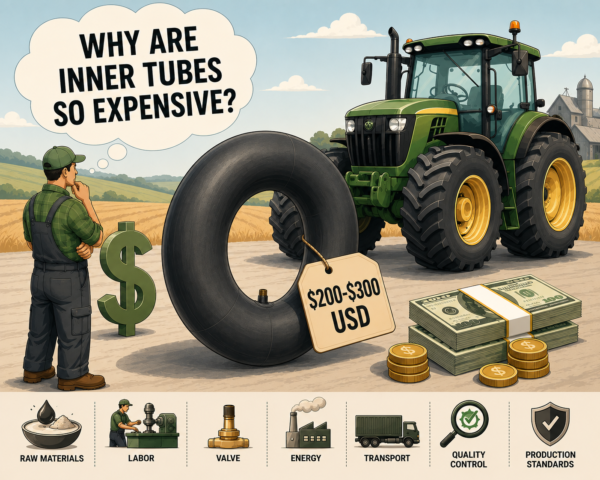
When people see an agricultural or industrial inner tube priced at $100-$300, many ask themselves: why does it cost so much? The answer is not simply the amount of rubber used. Seven main factors affect the price of an inner tube: raw materials, labor, the valve, energy, transport, quality control, and production standards.
Before we move on to the details, let look at the key points:
- the price depends on the quality of the rubber compound,
- labor accounts for a significant share of the cost,
- a heavier inner tube is not necessarily better,
- European inner tubes are often more expensive because of production standards,
- a cheap inner tube does not always mean savings.
If you want to understand why things are as described above, this article is for you.
P.S. The article below does not fully apply to bicycle inner tubes, which is indirectly explained in the section discussing the price of small and large inner tubes.
What really affects the price of an inner tube?
In general, raw materials and labor have the greatest impact on the price of an inner tube. Inner tubes are essentially made from a rubber compound and a valve. The compound contains various raw materials – rubber (natural, butyl, synthetic), carbon black and other powdered materials, oils, etc. As a result, the prices of the individual ingredients have a major impact on the price of the rubber compound, and those prices can change significantly and sometimes very rapidly. In addition, inner tube production still requires a great deal of human labor at every stage of the process, which means labor also accounts for a substantial share of the manufacturing cost.
Many of you have probably baked a cake – cheesecake, yeast cake, meringue, etc. A cake usually contains around 10 ingredients, and the pricing situation is similar. You probably remember periods when butter in stores costs 3-4 times more than usual. Imagine that an inner tube can contain as many as 30 ingredients, which is a great deal compared with a simple cake. Price fluctuations affecting some raw materials can significantly influence the final cost of the rubber compound. Natural rubber obtained from rubber trees, for example, depends on weather conditions and natural disasters. Butyl, in turn, is produced almost entirely from crude oil, the same oil used to produce automotive fuel. Any fluctuations or speculation can significantly change the final cost of the product.
Of course, industrial-scale production also requires several additional important factors to be taken into account.
Delivery time
Large quantities of raw materials must be ordered in advance, so prices are contracted for long periods, which can be beneficial when the price is low or unfavorable when it is high.
Origin of raw materials
Natural rubber comes from rubber trees, which can be grown in only a few countries worldwide. In the event of poor weather, rubber prices can rise sharply. Oil and petroleum prices also originate in only a few countries and are very prone to fluctuations.
Politics
Tariffs and sanctions have a direct impact on prices and purchasing conditions. Interestingly, many Asian countries have access to raw materials from sanctioned countries that European companies cannot access (sic!).
Why are inner tubes from Asia often cheaper than inner tubes made in Europe?
A provocative version of the question could be: Why are inner tubes from Asia not cheaper than inner tubes made in Europe? (because not all of them are). The answer is that inner tubes can be manufactured cheaply, expensively, or at a reasonable cost, and this does not necessarily depend on where they are produced. Almost anything can be added to an inner tube compound: asphalt, highly contaminated carbon black, low-quality oils, while anti-aging agents can be omitted, and the result will still be an inner tube – only a cheap, low-quality one. However, strict requirements can also be applied to the rubber and carbon black, the odor of the compound can be controlled, and anti-aging agents can be added, making the inner tube more expensive. Using the previous example, yeast cake can be made with margarine or butter, with or without strawberries, and the result will be different.
Okay, but let us assume that we have the same inner tube, made from similar raw materials, produced in Europe and in Asia. What would the price look like in that case, and what would affect it? Once again, there are several factors.
Raw materials
Raw materials can be purchased at lower or higher prices, and politics again plays a role. It should be remembered that Asian countries may have access to raw materials from sanctioned countries with which Europe does not officially trade (one particular country comes to mind). If a sanctioned country cannot trade with Europe, it probably sells its raw materials very cheaply in Asia. At the same time, it should be remembered that inner tubes produced from raw materials originating in that country still make their way to Europe (an irony).
Labor
After raw materials, labor is the second-largest component of the price. We all know that production in China or Vietnam can be very inexpensive, while wages in Europe are not as low. Incidentally, many developed Asian countries operate factories in countries where labor is inexpensive (Vietnam, Thailand, Malaysia, Cambodia).
Transport
Transport costs in the supply chain are highly variable and can ultimately account for nearly 20% of the product price, although they are usually below 10%. One important point is that, contrary to appearances, importing a container from China does not necessarily cost more than transport within Europe.
Fixed costs
More precisely, this means research and development, technology, administration, electricity, and gas. As far as the last two are concerned, electricity and gas can also cost more or less depending on where they are purchased. Asian countries may therefore have an advantage over Europe by buying electricity and gas from countries with which Europe cannot trade because of sanctions.
Environmental protection and occupational health and safety
The situation varies here because, while occupational safety and practices such as discharging wastewater into the sewage system are standard in Europe, this is not necessarily the case in Asia. To reduce costs, environmental problems are often transferred to countries that do not bear the cost in monetary terms, but rather in the condition the country will be left in after years of industrial pollution. Another problem is workplace safety – in many Asian countries, workplace accidents are unfortunately the norm rather than the exception.
Below is a shortened list of selected factors that affect the price of an inner tube.
| Factor | Impact on price |
|---|---|
| Rubber | Very high |
| Carbon black | High |
| Valve | Medium |
| Labor | Very high |
| Energy | Medium |
| Transport | Medium or high |
| Packaging | Low or medium |
| Machine wear | Low |
One important note: the table illustrates how large a share of the product cost is attributable to each component, although none of these components can be eliminated from production. Transport, for example, can periodically have a very large impact on price because there have been periods in the past when the cost of transporting a container to certain destinations exceeded USD 10,000.
So why are inner tubes so expensive?
Manufacturers that focus on high quality incur higher costs related to quality control, laboratory testing, workplace safety, and environmental protection. At Kabat, this includes:
- Quality of raw materials – every raw material is verified in the laboratory upon receipt
- Quality of the finished product – batches are inspected again in the laboratory, and every inner tube then undergoes quality control
- Fair pay – we employ people under employment contracts, pay for overtime, and subsidize meals in the factory canteen
- Workplace safety – the occupational health and safety team supervises safety, machines are safeguarded, traffic routes are secure, and inspections, repairs, sensor calibrations, etc. are carried out
- Environment – we store and recycle waste and do not contaminate groundwater
- Society, particularly the local community – we are unable to describe all the community initiatives in which we participate, and there are at least several every month
I hope this creates a picture of a company and a product that can be trusted. A Kabat inner tube is not a random product from Asia manufactured below the standards we uphold at Kabat. This affects the price, which may seem high, but it results not from an excessive margin, but from maintaining standards and quality.
Without demonizing Asian products, not all products from Asia are of low quality. There are products made in Asia that offer high quality and are manufactured with care for people, standards, and the environment. The products made by those companies compete with Kabat inner tubes, and we must acknowledge their quality and the positive opinions users have of them. Nevertheless, we believe that Kabat inner tubes have several positive characteristics that foreign products lack, including a very wide operating temperature range, mechanical strength, and very slow aging (no cracking after many years of use). These characteristics, together with the production methods and company philosophy described above, explain why a Kabat inner tube sometimes costs more than most products from Asia. In other words, the price is not arbitrary, but results from real expenditure on ensuring product quality and high production standards.
Why are large inner tubes proportionally cheaper than small ones?
Now that we know what determines the price of an inner tube, this section and the next one can help explain several points and dispel a few common myths.
Let us begin with the fact that large inner tubes are usually cheaper than small ones. This is simply because a large inner tube has a high proportion of material (raw materials and compound) relative to labor. In a small inner tube, the opposite is usually true – labor accounts for a higher share of the inner tube cost than the material. Here again, there are differences between Europe and Asia. If labor is inexpensive in some Asian countries, a small inner tube will cost less than the same inner tube made in Europe. Conversely, the high cost of labor in Europe can be offset in large inner tubes by the cost of an optimized compound – in large inner tubes, labor represents a smaller share of the inner tube cost than the material.
To summarize:
- Small inner tubes are generally more expensive when calculated in PLN/kg
- Large inner tubes are cheaper when calculated in PLN/kg
- If small and large inner tubes cost the same per kg, someone is averaging the price
Going into even greater detail, inner tubes of similar weight will never necessarily cost the same, because several factors affect the price, including the valve used (the difference here can amount to several dollars). In addition, more popular inner tube sizes are usually sold more cheaply than less popular ones, partly because of greater competition in a given size. Sometimes a manufacturer also offsets a lower margin with higher sales. One important point is that the price of a less popular inner tube is usually not increased; instead, the price of a popular inner tube is reduced. In other words, a manufacturer issues a price list at the prices it would like to achieve, but must reduce the price of popular inner tubes and ultimately earns less than it would like. It should be remembered that an entrepreneur’s profit is not greed, but their pay – what remains in the entrepreneur’s pocket is what they are able to earn, and the days when things were easy and pleasant seem to have ended.
Shouldn’t a heavier inner tube be cheaper than a lighter one?
A heavier inner tube does not mean higher quality. In fact, a lighter inner tube is usually higher quality than a heavier one. This is because a cheap rubber compound usually contains heavy ingredients such as asphalt and contaminated carbon black (the higher the carbon black grade, the lower its specific gravity). Unfortunately, users often believe that a heavier inner tube means higher quality. Since large inner tubes often weigh more than 20 kg, the difference in weight is very noticeable. For example, a cheap inner tube filled with low-quality fillers may weigh 25 kg, while a high-quality inner tube weighs 20 kg. Therefore, the belief that I get more for what I pay is completely unfounded in this case.
There is, of course, an exception when reinforced inner tubes are produced (see, for example Premium inner tubes available in Kabat’s range). In that case, the heavier inner tube is better than the lighter one, but the comparison is being made within the range of the same manufacturer, where there is a standard inner tube and a reinforced inner tube. Comparing the weights of inner tubes from different manufacturers generally makes no sense.
It is somewhat similar to ice cream, except that in this case heavier ice cream is of higher quality. Its composition is similar to that of a rubber compound. Ice cream is usually based on either milk/cream or water. Sometimes, however, more water is added or greater “overrun” is used to save money on more expensive milk. High-quality ice cream, on the other hand, has lower overrun and contains more high-quality ingredients, such as real cream, egg yolks, etc.
FAQ – frequently asked questions
Why are agricultural inner tubes so expensive?
The price of an inner tube depends primarily on the quality of the raw materials, production costs, labor, quality control, transport, and environmental and workplace safety standards. A high-quality inner tube is not made solely from rubber – it contains dozens of compound ingredients and a precisely manufactured valve.
What determines the price of an inner tube?
The greatest impact comes from the prices of rubber, carbon black, oils, and the other ingredients in the rubber compound, as well as labor costs, the quality of the materials used, the type of valve, and production and logistics costs.
Is a more expensive inner tube better?
Not always, but a higher price very often results from the use of better raw materials, more rigorous quality control, and higher production standards. It is worth comparing not only the price, but also the manufacturer, product specifications, and durability.
Why are inner tubes from Asia sometimes cheaper than European inner tubes?
The lower price may result from cheaper labor, lower energy costs, access to less expensive raw materials, and less restrictive environmental or workplace safety requirements. At the same time, high-quality inner tubes made in Asia are also available on the market.
Why are small inner tubes more expensive per kilogram?
In small inner tubes, labor accounts for a larger share of the cost than the material itself. This is why their price per kilogram is usually higher than that of large inner tubes.
Why are large inner tubes cheaper per kilogram?
In large inner tubes, material costs account for a much larger share of the price than labor costs, which is why their price per kilogram is usually lower.
Does a heavier inner tube mean higher quality?
No. Greater weight often results from the use of cheaper, heavier fillers. An inner tube made from a high-quality compound may be lighter while also being more durable and resistant to aging.
Does the type of valve affect the price of an inner tube?
Yes. Different types of valves can vary significantly in price, which is why two inner tubes of similar dimensions may cost different amounts.
Why do inner tube prices change over time?
They are affected by raw material prices, the geopolitical situation, exchange rates, energy and transport costs, and changes in global supply chains.