How to Choose the Right Rubber Compound for Your Application
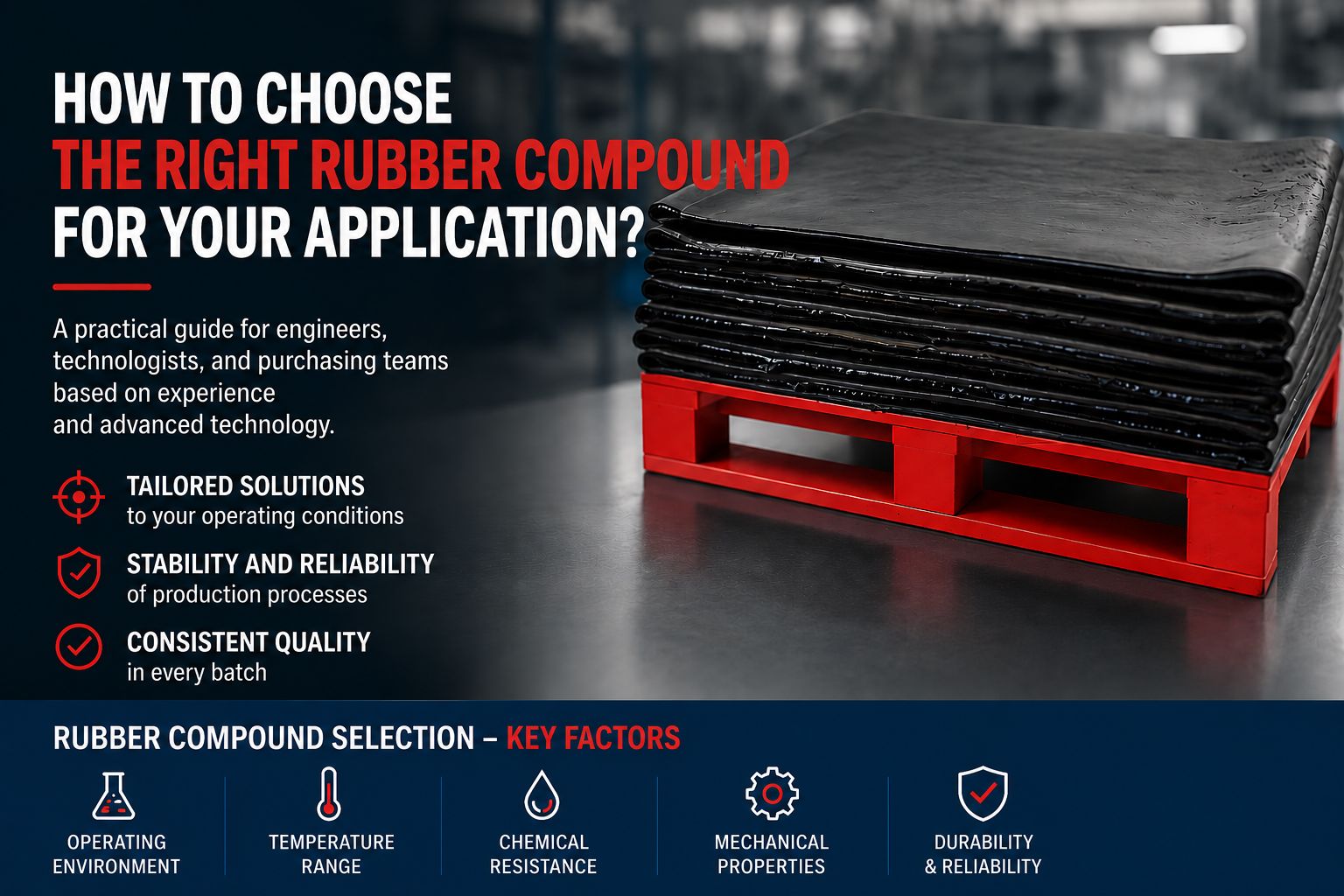
Why Choosing the Right Rubber Compound Matters
Selecting the right rubber compound has a direct impact on product durability, manufacturing stability, operational safety, and long-term production costs.
Even small formulation mistakes can lead to serious issues such as:
- cracking,
- hardening,
- swelling caused by oils,
- premature aging,
- poor abrasion resistance,
- unstable production parameters,
- increased product failures and warranty claims.
That is why manufacturers increasingly look for more than just a supplier. They need a technology partner capable of developing reliable industrial rubber compounds tailored to specific applications.
In this guide, we explain:
- how to choose the right rubber compound,
- which material properties matter most,
- differences between NR, SBR, NBR and EPDM,
- common rubber compounding mistakes,
- how to ensure consistent compound quality.
You can find out more about rubber compounds from this video:
Key Factors When Choosing a Rubber Compound
1. Operating Environment
The first step in rubber compound selection is understanding the working environment.
Key considerations include:
- exposure to oils and fuels,
- chemical resistance,
- UV exposure,
- ozone resistance,
- moisture and weather conditions,
- dynamic or static operation,
- food contact requirements.
For example:
NBR rubber compounds are commonly used in hydraulic seals because of their excellent oil resistance.
EPDM compounds are preferred for outdoor applications due to superior weather and UV resistance.
2. Temperature Resistance
Temperature significantly affects rubber performance and lifespan.
An improperly selected compound may:
- lose elasticity,
- become brittle,
- deform under heat,
- crack over time,
- accelerate material aging.
Typical Temperature Ranges
| Rubber Type | Typical Temperature Resistance |
|---|---|
| NR | -50°C to +80°C |
| SBR | -40°C to +100°C |
| NBR | -30°C to +120°C |
| EPDM | -50°C to +150°C |
| CR | -40°C to +120°C |
Rubber compounds should always be selected according to both continuous and peak operating temperatures.
3. Mechanical Performance Requirements
Industrial applications often require specific mechanical properties such as:
- abrasion resistance,
- tensile strength,
- fatigue resistance,
- flexibility,
- hardness,
- tear resistance.
For example, tire tread compounds must combine:
- wear resistance,
- grip performance,
- thermal stability,
- long-term durability.
NR vs SBR vs NBR vs EPDM Rubber Compounds
NR – Natural Rubber
Natural rubber provides excellent elasticity and dynamic performance.
Typical Applications
- tires,
- vibration dampers,
- dynamic industrial components.
Main Advantages
- high flexibility,
- excellent fatigue resistance,
- strong mechanical properties.
SBR – Styrene Butadiene Rubber
SBR is one of the most widely used industrial rubber compounds.
Typical Applications
- conveyor belts,
- tire treads,
- industrial rubber products.
Main Advantages
- good abrasion resistance,
- cost efficiency,
- balanced mechanical performance.
NBR – Oil Resistant Rubber Compounds
NBR compounds are ideal for applications involving oils, fuels, and lubricants.
Typical Applications
- seals,
- hydraulic components,
- automotive parts,
- hoses.
Main Advantages
- excellent oil resistance,
- strong mechanical performance,
- fuel resistance.
EPDM – Weather Resistant Rubber Compounds
EPDM is designed for outdoor and high-temperature environments.
Typical Applications
- outdoor seals,
- roofing systems,
- water installations,
- construction applications.
Main Advantages
- UV resistance,
- ozone resistance,
- weather durability,
- excellent thermal stability.
Common Rubber Compound Selection Mistakes
Focusing Only on Material Cost
The cheapest compound often generates higher long-term operational costs due to:
- faster wear,
- product failures,
- downtime,
- quality problems.
Total lifecycle cost is usually more important than initial material price.
Ignoring Real Operating Conditions
Many applications operate in harsher environments than initially expected.
Frequently overlooked factors include:
- temperature spikes,
- chemical exposure,
- UV radiation,
- dynamic mechanical stress.
Lack of Compound Consistency
Even the best formulation cannot guarantee quality without a stable production process.
Consistent industrial rubber compounds require:
- accurate dosing,
- controlled mixing parameters,
- raw material consistency,
- laboratory testing,
- real-time process monitoring.
Modern manufacturing systems such as SCADA and ERP/MRP solutions play an increasingly important role in maintaining repeatable compound quality.
How Professional Rubber Compounds Are Developed
Modern rubber compounding combines material science, automation, and quality control.
The development process typically includes:
- application analysis,
- polymer selection,
- formulation development,
- filler and additive optimization,
- laboratory testing,
- production trials,
- process optimization,
- quality verification.
Advanced mixing technologies such as Banbury mixers and Intermix systems help ensure:
- excellent dispersion,
- batch consistency,
- process repeatability,
- optimized production efficiency.
Why Consistency Matters in Industrial Rubber Compounds
For many manufacturers, the biggest challenge is not creating a compound — it is maintaining identical quality across every batch.
Consistent rubber compounds depend on:
- stable raw materials,
- controlled mixing conditions,
- accurate process automation,
- laboratory verification,
- experienced rubber technologists.
Professional testing typically includes:
- mechanical property testing,
- aging resistance,
- vulcanization analysis,
- abrasion resistance,
- hardness measurements.
This is especially important in industries such as:
- automotive,
- agriculture,
- heavy industry,
- tire manufacturing,
- industrial machinery.
When Custom Rubber Compounds Make Sense
Standard rubber formulations are not always sufficient for demanding industrial applications.
Custom rubber compounds are recommended when:
- products operate in harsh environments,
- unique properties are required,
- production optimization is necessary,
- quality issues occur,
- longer product lifespan is needed,
- industry-specific standards must be met.
A properly optimized compound can:
- reduce failures,
- improve product durability,
- stabilize manufacturing,
- lower operational costs.
How to Choose a Rubber Compound Manufacturer
When selecting a rubber compound manufacturer, companies should evaluate:
- technological expertise,
- quality consistency,
- laboratory capabilities,
- process control,
- production scalability,
- formulation development support,
- supply chain stability,
- technical consulting.
A reliable supplier should act as a long-term technology partner — not only as a material vendor.
Conclusion
Choosing the right rubber compound requires a combination of material expertise, process knowledge, and application understanding.
The right formulation directly affects:
- product durability,
- manufacturing stability,
- operational safety,
- production efficiency,
- long-term costs.
At Kabat, we have been developing and manufacturing industrial rubber compounds for more than 40 years. By combining advanced mixing technology, process automation, and strict quality control, we help manufacturers achieve reliable and repeatable production performance.
Looking for the Right Rubber Compound?
If you are looking for a rubber compound manufacturer that can help you select the optimal solution for your application, contact our team.
We can help you choose:
- the right rubber polymer type,
- compound parameters and performance properties,
- chemical and temperature resistance,
- a solution tailored to your production process.
Contact Us
- Request a technical consultation
- Ask for a rubber compound quotation
- Explore B2B cooperation opportunities
You can also review a list of example rubber compounds available on our website.