How to choose the right inner tube supplier
How to Choose the Right Inner Tube Supplier
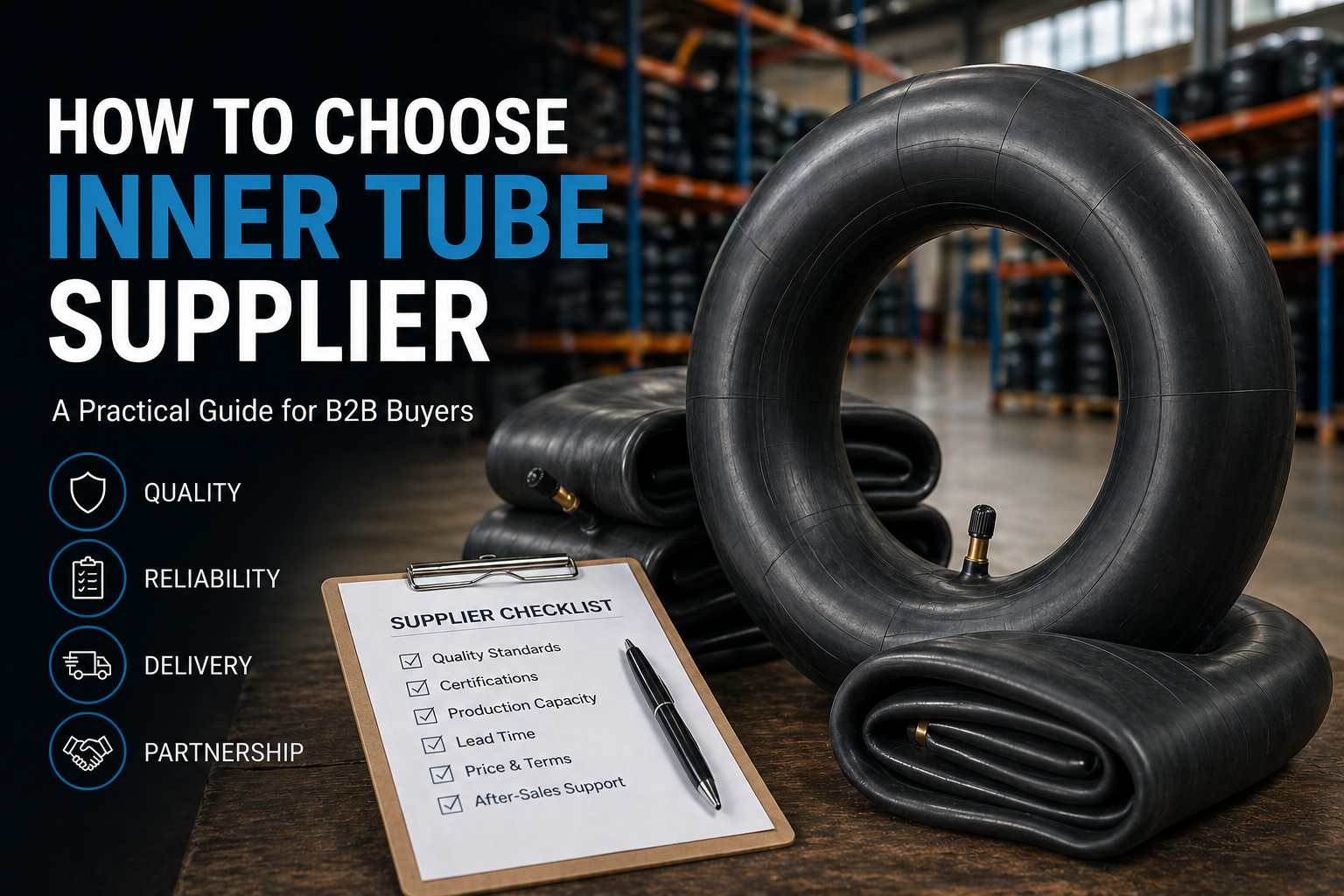
Quick Answer (Key Takeaways)
To choose a reliable inner tube supplier, focus on these critical factors:
- Product quality (rubber compound, splice strength, valve durability)
- Certifications (ISO, REACH, compliance standards)
- Production capacity and lead times
- Price-to-quality ratio (avoid cheapest options)
- Logistics and delivery reliability
- Communication and technical support
A strong supplier reduces complaints, improves customer satisfaction, and supports long-term growth.
What Does an Inner Tube Supplier Actually Do?
An inner tube supplier is responsible not only for manufacturing but also for ensuring:
- consistent product quality across batches
- compliance with international regulations
- reliable delivery timelines
- technical support and documentation
For distributors and OEMs, the supplier becomes a critical part of the supply chain, not just a vendor.
-
Define Your Requirements First
Before comparing suppliers, clarify your needs:
- Application: agricultural, OTR, industrial, truck
- Sizes and specifications
- Valve types
- Expected volumes (monthly / yearly)
- Standard vs customized products
Why this matters:
Different suppliers specialize in different segments. Misalignment here leads to quality or pricing issues later.
Looking for agricultural, OTR, or industrial inner tubes? Explore our full range of inner tube solutions.
-
Evaluate Product Quality and Materials
Quality is the primary differentiator between suppliers.
Key factors:
- Rubber compound (premium natural vs synthetic blends)
- Resistance to punctures and deformation
- Splice strength
- Thickness consistency
- Aging resistance
- Valve reliability
Always look for:
- Product samples
- Test reports
- Positive opinions
Important:
Low-quality tubes may look identical but fail faster in real-world conditions.
-
Check Certifications and Compliance
A reliable inner tube manufacturer should meet international standards.
Look for:
- ISO 9001 (quality management)
- Industry-specific standards
- Certificate of origin
Why it matters:
Lack of compliance can block market access, create legal risk or increase customs duties.
-
Assess Manufacturing Capabilities
Production capability determines whether a supplier can grow with your business.
Evaluate:
- Monthly production capacity
- Automation level
- Batch consistency
- Lead times
Ask:
- Can they handle repeat large orders?
- What happens during peak season?
-
Compare Pricing — But Focus on Total Cost
Price should never be the only decision factor.
Low-cost suppliers often compromise on:
- material quality
- product consistency
- durability
Instead, evaluate:
- price-to-quality ratio
- return rates
- complaint frequency
Key insight:
Cheaper tubes often generate higher long-term costs.
-
Analyze Logistics and Delivery Reliability
Even high-quality products fail if delivery is unreliable.
Key considerations:
- Lead times
- Reliable forwarders
- Flexibility in demand (do they keep stock?)
Impact:
Delays can disrupt your entire distribution chain.
-
Evaluate Communication and Support
Communication quality is a strong predictor of future problems.
Look for:
- Fast response times
- Clear and precise answers
- Technical support availability
- Dedicated account contact
- Strong language skills
Red flags:
- vague answers
- lack of technical knowledge
- incomprehensible decisions
-
Check Customization and Private Label Options
For distributors and brands, customization is often required.
Options to consider:
- Private labeling
- Custom specifications
- Packaging customization
-
Test Before Committing
Never rely solely on declarations.
Best practice:
- order samples
- perform field testing
- compare multiple suppliers
- ask or look for opinions
Outcome:
This reduces risk before scaling orders.
Conclusion
Choosing the right inner tube supplier is a strategic decision that affects product quality, customer satisfaction, and profitability.
A reliable supplier should offer:
- consistent quality
- compliance with regulations
- scalable production
- dependable logistics
- strong communication
Invest time in evaluation — it pays off in long-term stability.
FAQ
How do I choose a reliable inner tube supplier?
Focus on communication, quality, certifications, production capacity, pricing structure, and logistics reliability. Always test samples before placing large orders.
What certifications should an inner tube supplier have?
At minimum: ISO 9001, industry standards, EU-origin (if needed), REACH compliance (for EU), and PAHs compliance.
Why is the cheapest inner tube supplier risky?
Lower prices often indicate reduced material quality and higher failure rates, leading to increased complaints and long-term costs.
Should I test inner tubes before buying in bulk?
Yes. Sample testing and field validation are essential to verify quality and performance. We always provide samples on demand using standard production inner tubes, which proves consistent quality.
Looking for a reliable inner tube supplier? Explore our product range or contact our team to discuss your requirements.